Rivet API documentation
 |
Rivet 4.1.4
|
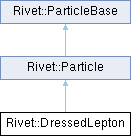
A charged lepton meta-particle created by clustering photons close to the bare lepton. More...
#include <DressedLepton.hh>
Public Member Functions | |
| DressedLepton (const Particle &dlepton) | |
| Copy constructor (from Particle). | |
| DressedLepton (const Particle &lepton, const Particles &photons, bool momsum=true) | |
| Components constructor. | |
| void | addPhoton (const Particle &p, bool momsum=true) |
| Add a photon to the dressed lepton. | |
| const Particle & | bareLepton () const |
| Retrieve the bare lepton. | |
| const Particles | photons () const |
| Retrieve the clustered photons. | |
Kinematic properties | |
| const FourMomentum & | momentum () const |
| The momentum. | |
| Particle & | setMomentum (const FourMomentum &momentum) |
| Set the momentum. | |
| Particle & | setMomentum (double E, double px, double py, double pz) |
| Set the momentum via components. | |
| Particle & | transformBy (const LorentzTransform <) |
| Apply an active Lorentz transform to this particle. | |
Positional properties | |
| const FourVector & | origin () const |
| Particle & | setOrigin (const FourVector &position) |
| Set the origin position. | |
| Particle & | setOrigin (double t, double x, double y, double z) |
| Set the origin position via components. | |
Displacement properties | |
Add a decay vertex accessor with std::optional | |
| Vector3 | closestApproach () const |
| Find the point of closest approach (and hence the impact parameter) to the primary vertex. | |
| double | impactParam (bool signedip=false) const |
Other representations and implicit casts to momentum-like objects | |
| |
| virtual fastjet::PseudoJet | pseudojet () const |
| Converter to FastJet3 PseudoJet. | |
| operator PseudoJet () const | |
| Cast operator to FastJet3 PseudoJet. | |
| Particle & | setGenParticle (ConstGenParticlePtr gp) |
| Set a const pointer to the original GenParticle. | |
| ConstGenParticlePtr | genParticle () const |
| Get a const pointer to the original GenParticle. | |
| operator ConstGenParticlePtr () const | |
Particle ID code accessors | |
| PdgId | pid () const |
| This Particle's PDG ID code. | |
| PdgId | abspid () const |
| Absolute value of the PDG ID code. | |
Charge | |
| double | charge () const |
| The charge of this Particle. | |
| double | abscharge () const |
| The absolute charge of this Particle. | |
| int | charge3 () const |
| Three times the charge of this Particle (i.e. integer multiple of smallest quark charge). | |
| int | abscharge3 () const |
| Three times the absolute charge of this Particle (i.e. integer multiple of smallest quark charge). | |
| bool | isCharged () const |
| Is this Particle charged? | |
Particle species | |
| bool | isHadron () const |
| Is this a hadron? | |
| bool | isMeson () const |
| Is this a meson? | |
| bool | isBaryon () const |
| Is this a baryon? | |
| bool | isLepton () const |
| Is this a lepton? | |
| bool | isChargedLepton () const |
| Is this a charged lepton? | |
| bool | isNeutrino () const |
| Is this a neutrino? | |
| bool | hasBottom () const |
| Does this (hadron) contain a b quark? | |
| bool | hasCharm () const |
| Does this (hadron) contain a c quark? | |
| bool | hasStrange () const |
| bool | isVisible () const |
| Is this particle potentially visible in a detector? | |
| bool | isParton () const |
| Is this a parton? (Hopefully not very often... fiducial FTW). | |
Constituents (for composite particles) | |
| virtual void | setConstituents (const Particles &cs, bool setmom=false) |
| Set direct constituents of this particle. | |
| virtual void | addConstituent (const Particle &c, bool addmom=false) |
| Add a single direct constituent to this particle. | |
| virtual void | addConstituents (const Particles &cs, bool addmom=false) |
| Add direct constituents to this particle. | |
| bool | isComposite () const |
| Determine if this Particle is a composite of other Rivet Particles. | |
| const Particles & | constituents () const |
| Direct constituents of this particle, returned by reference. | |
| const Particles | constituents (const ParticleSorter &sorter) const |
| Direct constituents of this particle, sorted by a functor. | |
| const Particles | constituents (const Cut &c) const |
| Direct constituents of this particle, filtered by a Cut. | |
| const Particles | constituents (const Cut &c, const ParticleSorter &sorter) const |
| Direct constituents of this particle, sorted by a functor. | |
| const Particles | constituents (const ParticleSelector &selector) const |
| Direct constituents of this particle, filtered by a selection functor. | |
| const Particles | constituents (const ParticleSelector &selector, const ParticleSorter &sorter) const |
| Direct constituents of this particle, filtered and sorted by functors. | |
| Particles | rawConstituents () const |
| Fundamental constituents of this particle. | |
| const Particles | rawConstituents (const ParticleSorter &sorter) const |
| Fundamental constituents of this particle, sorted by a functor. | |
| const Particles | rawConstituents (const Cut &c) const |
| Fundamental constituents of this particle, filtered by a Cut. | |
| const Particles | rawConstituents (const Cut &c, const ParticleSorter &sorter) const |
| Fundamental constituents of this particle, sorted by a functor. | |
| const Particles | rawConstituents (const ParticleSelector &selector) const |
| Fundamental constituents of this particle, filtered by a selection functor. | |
| const Particles | rawConstituents (const ParticleSelector &selector, const ParticleSorter &sorter) const |
| Fundamental constituents of this particle, filtered and sorted by functors. | |
Ancestry and origins (for fundamental particles with a HepMC link) | |
| bool | isPhysical (bool include_beams=false) const |
| Is this particle recorded as physically meaningful in the event record? | |
| bool | hasPhysicalAncestor (const Cut &c=Cuts::OPEN) const |
| Does this (outgoing) particle have physically meaningful (outgoing) parents in the event record? | |
| Particles | parents (const Cut &c=Cuts::OPEN) const |
| Particles | parents (const ParticleSelector &f) const |
| bool | hasParentWith (const ParticleSelector &f) const |
| bool | hasParentWith (const Cut &c) const |
| bool | hasParentWithout (const ParticleSelector &f) const |
| bool | hasParentWithout (const Cut &c) const |
| Particles | ancestors (const Cut &c=Cuts::OPEN, bool only_physical=true) const |
| Particles | ancestors (const ParticleSelector &f, bool only_physical=true) const |
| bool | hasAncestorWith (const ParticleSelector &f, bool only_physical=true) const |
| bool | hasAncestorWith (const Cut &c, bool only_physical=true) const |
| bool | hasAncestorWithout (const ParticleSelector &f, bool only_physical=true) const |
| bool | hasAncestorWithout (const Cut &c, bool only_physical=true) const |
| bool | fromBottom () const |
| Determine whether the particle is from a b-hadron decay. | |
| bool | fromCharm () const |
| Determine whether the particle is from a c-hadron decay. | |
| bool | fromHadron () const |
| Determine whether the particle is from a hadron decay. | |
| bool | fromTau (bool prompt_taus_only=false) const |
| Determine whether the particle is from a tau decay. | |
| bool | fromPromptTau () const |
| Determine whether the particle is from a prompt tau decay. | |
| bool | fromHadronicTau (bool prompt_taus_only=false) const |
| Determine whether the particle is from a tau which decayed hadronically. | |
| bool | isDirect (bool allow_from_direct_tau=false, bool allow_from_direct_mu=false) const |
| Shorthand definition of 'promptness' based on set definition flags. | |
| bool | isPrompt (bool allow_from_prompt_tau=false, bool allow_from_prompt_mu=false) const |
| Alias for isDirect. | |
Decay info | |
| bool | isStable () const |
| Whether this particle is stable according to the generator. | |
| Particles | children (const Cut &c=Cuts::OPEN) const |
| Get a list of the direct descendants from the current particle (with optional selection Cut). | |
| Particles | children (const ParticleSelector &f) const |
| Get a list of the direct descendants from the current particle (with selector function). | |
| bool | hasChildWith (const ParticleSelector &f) const |
| bool | hasChildWith (const Cut &c) const |
| bool | hasChildWithout (const ParticleSelector &f) const |
| bool | hasChildWithout (const Cut &c) const |
| Particles | allDescendants (const Cut &c=Cuts::OPEN, bool remove_duplicates=true) const |
| Get a list of all the descendants from the current particle (with optional selection Cut). | |
| Particles | allDescendants (const ParticleSelector &f, bool remove_duplicates=true) const |
| Get a list of all the descendants from the current particle (with selector function). | |
| bool | hasDescendantWith (const ParticleSelector &f, bool remove_duplicates=true) const |
| bool | hasDescendantWith (const Cut &c, bool remove_duplicates=true) const |
| bool | hasDescendantWithout (const ParticleSelector &f, bool remove_duplicates=true) const |
| bool | hasDescendantWithout (const Cut &c, bool remove_duplicates=true) const |
| Particles | stableDescendants (const Cut &c=Cuts::OPEN) const |
| Particles | stableDescendants (const ParticleSelector &f) const |
| Get a list of all the stable descendants from the current particle (with selector function). | |
| bool | hasStableDescendantWith (const ParticleSelector &f) const |
| bool | hasStableDescendantWith (const Cut &c) const |
| bool | hasStableDescendantWithout (const ParticleSelector &f) const |
| bool | hasStableDescendantWithout (const Cut &c) const |
| double | flightLength () const |
Duplicate testing | |
| bool | isFirstWith (const ParticleSelector &f) const |
| Determine whether a particle is the first in a decay chain to meet the function requirement. | |
| bool | isFirstWithout (const ParticleSelector &f) const |
| Determine whether a particle is the first in a decay chain not to meet the function requirement. | |
| bool | isLastWith (const ParticleSelector &f) const |
| Determine whether a particle is the last in a decay chain to meet the function requirement. | |
| bool | isLastWithout (const ParticleSelector &f) const |
| Determine whether a particle is the last in a decay chain not to meet the function requirement. | |
Comparison | |
| bool | isSame (const Particle &other) const |
Effective momentum accessors | |
| const FourMomentum & | mom () const |
| Get the equivalent momentum four-vector (const) (alias). | |
| const FourMomentum & | p4 () const |
| Get the equivalent momentum four-vector (const) (alias). | |
| operator const FourMomentum & () const | |
| Cast operator for conversion to FourMomentum. | |
Convenience access to the effective 4-vector properties | |
| double | E () const |
| Get the energy directly. | |
| double | energy () const |
| Get the energy directly (alias). | |
| double | E2 () const |
| Get the energy-squared. | |
| double | energy2 () const |
| Get the energy-squared (alias). | |
| double | pt () const |
| Get the \( p_T \) directly. | |
| double | pT () const |
| Get the \( p_T \) directly (alias). | |
| double | perp () const |
| Get the \( p_T \) directly (alias). | |
| double | pt2 () const |
| Get the \( p_T^2 \) directly. | |
| double | pT2 () const |
| Get the \( p_T^2 \) directly (alias). | |
| double | perp2 () const |
| Get the \( p_T^2 \) directly (alias). | |
| double | Et () const |
| Get the \( E_T \) directly. | |
| double | Et2 () const |
| Get the \( E_T^2 \) directly. | |
| double | mass () const |
| Get the mass directly. | |
| double | mass2 () const |
| Get the mass**2 directly. | |
| double | pseudorapidity () const |
| Get the \( \eta \) directly. | |
| double | eta () const |
| Get the \( \eta \) directly (alias). | |
| double | abspseudorapidity () const |
| Get the \( |\eta| \) directly. | |
| double | abseta () const |
| Get the \( |\eta| \) directly (alias). | |
| double | rapidity () const |
| Get the \( y \) directly. | |
| double | rap () const |
| Get the \( y \) directly (alias). | |
| double | absrapidity () const |
| Get the \( |y| \) directly. | |
| double | absrap () const |
| Get the \( |y| \) directly (alias). | |
| double | azimuthalAngle (const PhiMapping mapping=ZERO_2PI) const |
| Azimuthal angle \( \phi \). | |
| double | phi (const PhiMapping mapping=ZERO_2PI) const |
| Get the \( \phi \) directly. | |
| ThreeMomentum | p3 () const |
| Get the 3-momentum directly. | |
| double | p () const |
| Get the 3-momentum magnitude directly. | |
| double | p2 () const |
| Get the 3-momentum magnitude-squared directly. | |
| Vector3 | ptvec () const |
| Get the transverse 3-momentum directly. | |
| Vector3 | pTvec () const |
| Get the transverse 3-momentum directly. | |
| double | px () const |
| x component of momentum. | |
| double | py () const |
| y component of momentum. | |
| double | pz () const |
| z component of momentum. | |
| double | px2 () const |
| x component of momentum, squared. | |
| double | py2 () const |
| y component of momentum, squared. | |
| double | pz2 () const |
| z component of momentum, squared. | |
| double | polarAngle () const |
| Angle subtended by the 3-vector and the z-axis. | |
| double | theta () const |
| Synonym for polarAngle. | |
| double | angle (const ParticleBase &v) const |
| Angle between this vector and another. | |
| double | angle (const FourVector &v) const |
| Angle between this vector and another. | |
| double | angle (const Vector3 &v3) const |
| Angle between this vector and another (3-vector). | |
| double | dot (const ParticleBase &v) const |
| Lorentz dot product between this 4-vector and another. | |
| double | dot (const FourVector &v) const |
| Angle between this 4-vector and another. | |
Detailed Description
A charged lepton meta-particle created by clustering photons close to the bare lepton.
- Deprecated
- Prefer to use Particle.constituents()
Constructor & Destructor Documentation
◆ DressedLepton()
| Rivet::DressedLepton::DressedLepton | ( | const Particle & | lepton, |
| const Particles & | photons, | ||
| bool | momsum = true ) |
Components constructor.
- Note
- This is not a copy constructor, hence the explicit second argument even if empty
References Rivet::Particle::Particle(), and photons().
Member Function Documentation
◆ addPhoton()
| void Rivet::DressedLepton::addPhoton | ( | const Particle & | p, |
| bool | momsum = true ) |
Add a photon to the dressed lepton.
- Todo
- Deprecate and override add/setConstituents instead?
References Rivet::Particle::Particle(), and Rivet::ParticleBase::p().
◆ ancestors() [1/2]
|
inherited |
Get a list of the ancestors of the current particle (with optional selection Cut)
- Note
- By default only physical ancestors, with status=2, are returned.
- This is valid in MC, but may not be answerable experimentally – use this function with care when replicating experimental analyses!
Referenced by ancestors(), and hasAncestorWith().
◆ ancestors() [2/2]
|
inlineinherited |
Get a list of the direct parents of the current particle (with selector function)
- Note
- By default only physical ancestors, with status=2, are returned.
- This is valid in MC, but may not be answerable experimentally – use this function with care when replicating experimental analyses!
References ancestors(), and Rivet::select().
◆ children()
|
inherited |
Get a list of the direct descendants from the current particle (with optional selection Cut).
- Todo
- isDecayed? How to restrict to physical particles?
Referenced by children(), hasChildWith(), isLastWith(), Rivet::isRadiative(), Rivet::TAU_EFF_ATLAS_RUN1_MEDIUM(), and Rivet::TAU_EFF_ATLAS_RUN2_MEDIUM().
◆ closestApproach()
|
inlineinherited |
Find the point of closest approach (and hence the impact parameter) to the primary vertex.
The calculation of this uses 3-vector algebra: the relation between closest-approach point b, particle origin v, and particle-momentum unit vector phat is v = b + ap with a floating constant. The value of a is fixed by minimising |b_perp|^2, giving a = (phat_x v_x + phat_y v_y) / (phat_x^2 + phat_y^2) = (phat_perp . v_perp) / phat_perp^2 .
References Rivet::Vector3::dot(), origin(), Rivet::ParticleBase::p3(), Rivet::Vector3::perp2(), Rivet::Vector3::perpVec(), Rivet::Vector3::unit(), and Rivet::FourVector::vector3().
◆ constituents() [1/6]
|
inlineinherited |
Direct constituents of this particle, returned by reference.
The returned vector will be empty if this particle is non-composite, and its entries may themselves be composites.
Referenced by constituents(), constituents(), constituents(), constituents(), constituents(), isComposite(), and Rivet::DressedLepton::photons().
◆ constituents() [2/6]
|
inlineinherited |
Direct constituents of this particle, filtered by a Cut.
- Note
- Returns a copy, thanks to the filtering
References constituents(), and Rivet::select().
◆ constituents() [3/6]
|
inlineinherited |
Direct constituents of this particle, sorted by a functor.
- Note
- Returns a copy, thanks to the filtering and sorting
References constituents(), and Rivet::sortBy().
◆ constituents() [4/6]
|
inlineinherited |
Direct constituents of this particle, filtered by a selection functor.
- Note
- Returns a copy, thanks to the filtering
References constituents(), and Rivet::select().
◆ constituents() [5/6]
|
inlineinherited |
Direct constituents of this particle, filtered and sorted by functors.
- Note
- Returns a copy, thanks to the filtering and sorting
References constituents(), and Rivet::sortBy().
◆ constituents() [6/6]
|
inlineinherited |
Direct constituents of this particle, sorted by a functor.
- Note
- Returns a copy, thanks to the sorting
References constituents(), and Rivet::sortBy().
◆ flightLength()
|
inherited |
Flight length of the particle from origin to decay
- Note
- Divide by mm or cm as usual to get the appropriate units.
◆ fromBottom()
|
inherited |
Determine whether the particle is from a b-hadron decay.
- Note
- This question is valid in MC, but may not be perfectly answerable experimentally – use this function with care when replicating experimental analyses!
◆ fromCharm()
|
inherited |
Determine whether the particle is from a c-hadron decay.
- Note
- If a hadron contains b and c quarks it is considered a bottom hadron and NOT a charm hadron.
- This question is valid in MC, but may not be perfectly answerable experimentally – use this function with care when replicating experimental analyses!
◆ fromHadron()
|
inherited |
Determine whether the particle is from a hadron decay.
- Note
- This question is valid in MC, but may not be perfectly answerable experimentally – use this function with care when replicating experimental analyses!
◆ fromHadronicTau()
|
inherited |
Determine whether the particle is from a tau which decayed hadronically.
- Note
- This question is valid in MC, but may not be perfectly answerable experimentally – use this function with care when replicating experimental analyses!
◆ fromPromptTau()
|
inlineinherited |
Determine whether the particle is from a prompt tau decay.
- Note
- This question is valid in MC, but may not be perfectly answerable experimentally – use this function with care when replicating experimental analyses!
References fromTau().
◆ fromTau()
|
inherited |
Determine whether the particle is from a tau decay.
- Note
- This question is valid in MC, but may not be perfectly answerable experimentally – use this function with care when replicating experimental analyses!
Referenced by fromPromptTau().
◆ hasAncestorWith() [1/2]
|
inherited |
Check whether any particle in the particle's ancestor list has the requested property
- Note
- This question is valid in MC, but may not be answerable experimentally – use this function with care when replicating experimental analyses!
◆ hasAncestorWith() [2/2]
|
inlineinherited |
Check whether any particle in the particle's ancestor list has the requested property
- Note
- This question is valid in MC, but may not be answerable experimentally – use this function with care when replicating experimental analyses!
References ancestors().
Referenced by hasAncestorWithout().
◆ hasAncestorWithout() [1/2]
|
inherited |
Check whether any particle in the particle's ancestor list does not have the requested property
- Note
- This question is valid in MC, but may not be answerable experimentally – use this function with care when replicating experimental analyses!
◆ hasAncestorWithout() [2/2]
|
inlineinherited |
Check whether any particle in the particle's ancestor list does not have the requested property
- Note
- This question is valid in MC, but may not be answerable experimentally – use this function with care when replicating experimental analyses!
References Particle(), hasAncestorWith(), and Rivet::ParticleBase::p().
◆ hasChildWith() [1/2]
|
inherited |
Check whether any direct child of this particle has the requested property
- Note
- This question is valid in MC, but may not be answerable experimentally – use this function with care when replicating experimental analyses!
◆ hasChildWith() [2/2]
|
inlineinherited |
Check whether any direct child of this particle has the requested property
- Note
- This question is valid in MC, but may not be answerable experimentally – use this function with care when replicating experimental analyses!
References children().
Referenced by hasChildWithout().
◆ hasChildWithout() [1/2]
|
inherited |
Check whether any direct child of this particle does not have the requested property
- Note
- This question is valid in MC, but may not be answerable experimentally – use this function with care when replicating experimental analyses!
◆ hasChildWithout() [2/2]
|
inlineinherited |
Check whether any direct child of this particle does not have the requested property
- Note
- This question is valid in MC, but may not be answerable experimentally – use this function with care when replicating experimental analyses!
References Particle(), hasChildWith(), and Rivet::ParticleBase::p().
◆ hasDescendantWith() [1/2]
|
inherited |
Check whether any descendant of this particle has the requested property
- Note
- This question is valid in MC, but may not be answerable experimentally – use this function with care when replicating experimental analyses!
◆ hasDescendantWith() [2/2]
|
inlineinherited |
Check whether any descendant of this particle has the requested property
- Note
- This question is valid in MC, but may not be answerable experimentally – use this function with care when replicating experimental analyses!
References allDescendants().
Referenced by hasDescendantWithout().
◆ hasDescendantWithout() [1/2]
|
inherited |
Check whether any descendant of this particle does not have the requested property
- Note
- This question is valid in MC, but may not be answerable experimentally – use this function with care when replicating experimental analyses!
◆ hasDescendantWithout() [2/2]
|
inlineinherited |
Check whether any descendant of this particle does not have the requested property
- Note
- This question is valid in MC, but may not be answerable experimentally – use this function with care when replicating experimental analyses!
References Particle(), hasDescendantWith(), and Rivet::ParticleBase::p().
◆ hasParentWith() [1/2]
|
inherited |
Check whether any particle in the particle's parent list has the requested property
- Note
- This question is valid in MC, but may not be answerable experimentally – use this function with care when replicating experimental analyses!
◆ hasParentWith() [2/2]
|
inlineinherited |
Check whether any particle in the particle's parent list has the requested property
- Note
- This question is valid in MC, but may not be answerable experimentally – use this function with care when replicating experimental analyses!
References parents().
Referenced by hasParentWithout().
◆ hasParentWithout() [1/2]
|
inherited |
Check whether any particle in the particle's parent list does not have the requested property
- Note
- This question is valid in MC, but may not be answerable experimentally – use this function with care when replicating experimental analyses!
◆ hasParentWithout() [2/2]
|
inlineinherited |
Check whether any particle in the particle's parent list does not have the requested property
- Note
- This question is valid in MC, but may not be answerable experimentally – use this function with care when replicating experimental analyses!
References Particle(), hasParentWith(), and Rivet::ParticleBase::p().
◆ hasPhysicalAncestor()
|
inherited |
Does this (outgoing) particle have physically meaningful (outgoing) parents in the event record?
Used for defining primary final-state particles as either status=1 or =2, with no status=2 parents, i.e. the first physical particles post-hadronisation.
◆ hasStableDescendantWith() [1/2]
|
inherited |
Check whether any stable descendant of this particle has the requested property
- Note
- This question is valid in MC, but may not be answerable experimentally – use this function with care when replicating experimental analyses!
◆ hasStableDescendantWith() [2/2]
|
inlineinherited |
Check whether any stable descendant of this particle has the requested property
- Note
- This question is valid in MC, but may not be answerable experimentally – use this function with care when replicating experimental analyses!
References stableDescendants().
Referenced by hasStableDescendantWithout().
◆ hasStableDescendantWithout() [1/2]
|
inherited |
Check whether any stable descendant of this particle does not have the requested property
- Note
- This question is valid in MC, but may not be answerable experimentally – use this function with care when replicating experimental analyses!
◆ hasStableDescendantWithout() [2/2]
|
inlineinherited |
Check whether any stable descendant of this particle does not have the requested property
- Note
- This question is valid in MC, but may not be answerable experimentally – use this function with care when replicating experimental analyses!
References Particle(), hasStableDescendantWith(), and Rivet::ParticleBase::p().
◆ isDirect()
|
inherited |
Shorthand definition of 'promptness' based on set definition flags.
A "direct" particle is one directly connected to the hard process. It is a preferred alias for "prompt", since it has no confusing implications about distinguishability by timing information.
The boolean arguments allow a decay lepton to be considered direct if its parent was a "real" direct lepton.
- Note
- This one doesn't make any judgements about final-stateness
Referenced by isPrompt().
◆ isPhysical()
|
inherited |
Is this particle recorded as physically meaningful in the event record?
Only HepMC particles with status=1, 2, or 4 have definite physical meaning rather than artifacts of calculations or models. Generally we are not asking questions about the beams, so they are excluded unless explicitly activated.
◆ isSame()
|
inlineinherited |
Compare particles, based on "external" characteristics, with a little angular tolerance
- Note
- Not a deep comparison: GenParticle ptr and constituents are not used in the comparison
References Particle(), Rivet::isZero(), Rivet::ParticleBase::mom(), origin(), and pid().
Referenced by Rivet::isSame().
◆ momentum()
|
inlinevirtualinherited |
◆ operator ConstGenParticlePtr()
|
inlineexplicitinherited |
Cast operator for conversion to GenParticle*
- Note
- Not implicit since that would enable accidental Particle::operator== comparisons
References genParticle().
◆ origin()
|
inlineinherited |
The origin position (and time).
- Todo
- Name more clearly... originVertex?
Referenced by closestApproach(), and isSame().
◆ parents() [1/2]
|
inherited |
Get a list of the direct parents of the current particle (with optional selection Cut)
- Note
- This is valid in MC, but may not be answerable experimentally – use this function with care when replicating experimental analyses!
Referenced by hasParentWith(), isFirstWith(), Rivet::isRadiative(), and parents().
◆ parents() [2/2]
|
inlineinherited |
Get a list of the direct parents of the current particle (with selector function)
- Note
- This is valid in MC, but may not be answerable experimentally – use this function with care when replicating experimental analyses!
References parents(), and Rivet::select().
◆ rawConstituents() [1/6]
|
inherited |
Fundamental constituents of this particle.
- Note
- Returns {{*this}} if this particle is non-composite.
Referenced by rawConstituents(), rawConstituents(), rawConstituents(), rawConstituents(), and rawConstituents().
◆ rawConstituents() [2/6]
|
inlineinherited |
Fundamental constituents of this particle, filtered by a Cut.
- Note
- Returns a copy, thanks to the filtering
References rawConstituents(), and Rivet::select().
◆ rawConstituents() [3/6]
|
inlineinherited |
Fundamental constituents of this particle, sorted by a functor.
- Note
- Returns a copy, thanks to the filtering and sorting
References rawConstituents(), and Rivet::sortBy().
◆ rawConstituents() [4/6]
|
inlineinherited |
Fundamental constituents of this particle, filtered by a selection functor.
- Note
- Returns a copy, thanks to the filtering
References rawConstituents(), and Rivet::select().
◆ rawConstituents() [5/6]
|
inlineinherited |
Fundamental constituents of this particle, filtered and sorted by functors.
- Note
- Returns a copy, thanks to the filtering and sorting
References rawConstituents(), and Rivet::sortBy().
◆ rawConstituents() [6/6]
|
inlineinherited |
Fundamental constituents of this particle, sorted by a functor.
- Note
- Returns a copy, thanks to the sorting
References rawConstituents(), and Rivet::sortBy().
◆ stableDescendants()
|
inherited |
Get a list of all the stable descendants from the current particle (with optional selection Cut)
- Todo
Use recursion through replica-avoiding MCUtils functions to avoid bookkeeping duplicates
Insist that the current particle is post-hadronization, otherwise throw an exception?
Referenced by hasStableDescendantWith(), and stableDescendants().
The documentation for this class was generated from the following file:
- /builds/hepcedar/rivet/include/Rivet/DressedLepton.hh
Generated on for Rivet by
 1.15.0